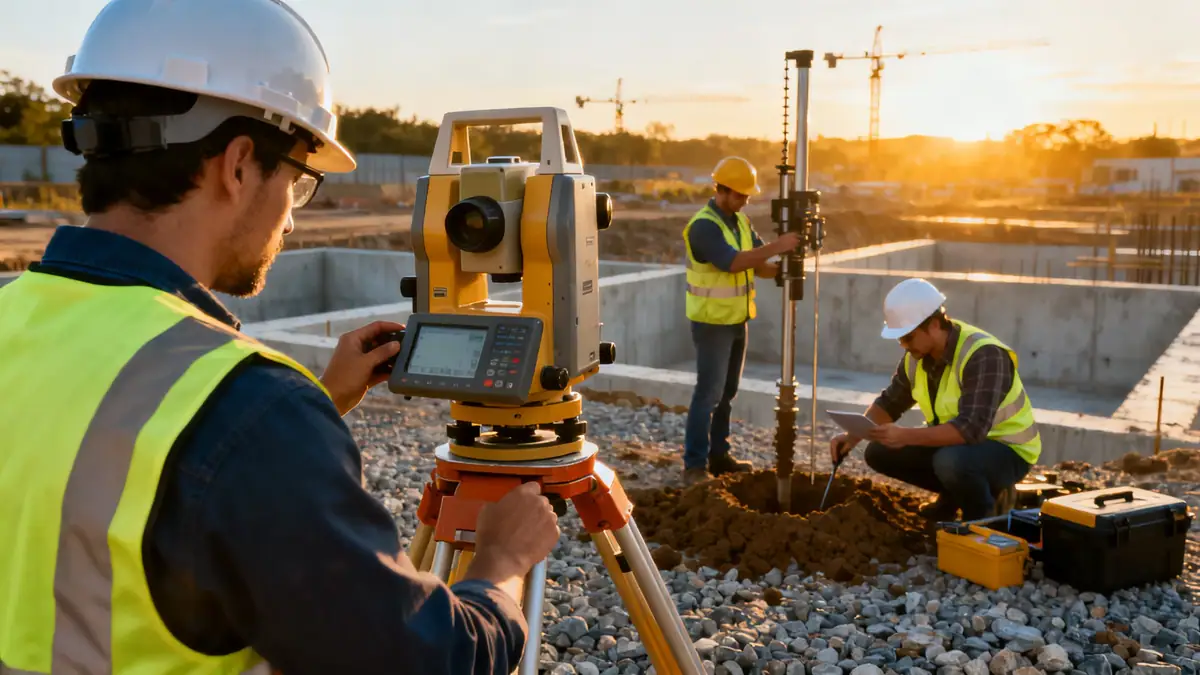
Methodology

Our geotechnical approach in Wolverhampton begins with a comprehensive desk study and site reconnaissance to identify potential hazards such as shallow mine workings or variable drift deposits. We then deploy a tailored investigation programme, including boreholes with standard penetration testing (SPT) to British Standard BS 5930, and trial pits to assess shallow strata. Soil samples are subjected to classification and strength tests in our soil mechanics laboratory, following ASTM D4318 for Atterberg limits. This phased methodology allows us to characterise the ground profile accurately and produce robust foundation recommendations for each site.
Reference Technical Parameters
| Parameter | Reference Value |
|---|---|
| Predominant soil type | Glacial till (boulder clay) overlying Mercia Mudstone |
| Maximum seismic acceleration (PGA) | 0.05g to 0.10g (low seismicity per Eurocode 8) |
| Typical groundwater level | 3 to 8 m below ground surface |
| Bedrock depth | 10 to 20 m (Mercia Mudstone) |
| Typical N60 range | 15 to 35 blows per 300 mm (glacial till) |
Local Considerations — Wolverhampton
Wolverhampton is underlain predominantly by glacial till (boulder clay), which can contain cobbles and boulders, complicating drilling and excavation. The bedrock is Mercia Mudstone, which may be weak and prone to swelling when exposed. Groundwater is generally at moderate depth, but perched water can occur in sand lenses. The area has low seismicity, with a peak ground acceleration (PGA) below 0.10g per Eurocode 8, so seismic design is minimal. However, historical mining in the wider Black Country region may affect site stability, requiring careful desk study. For comprehensive services, our spt boring operations are well-suited to these conditions. Our geotechnical engineering en Birmingham team collaborates closely on regional projects.
Request a Quote
Our team reviews your project and issues an initial report at no cost.
Or write us directly at [email protected]
Services in Wolverhampton
Applicable Standards
- BS 5930:2015 Code of practice for ground investigations
- Eurocode 7 (BS EN 1997-1 and 1997-2)
- ASTM D1586 Standard Test Method for Standard Penetration Test (SPT)
- ASTM D4318 Standard Test Methods for Liquid Limit, Plastic Limit, and Plasticity Index of Soils
- Eurocode 8 (BS EN 1998-1) for seismic design
Frequently Asked Questions
What are the typical soil conditions in Wolverhampton?
Wolverhampton is underlain by glacial till (boulder clay) over Mercia Mudstone bedrock. The till can contain cobbles and boulders, and the mudstone may be weak and susceptible to swelling. Groundwater is usually between 3 and 8 m depth, but local variations occur.
Is seismic design required for projects in Wolverhampton?
Seismic design is generally not a major concern in Wolverhampton, as the peak ground acceleration (PGA) is low (<0.10g per Eurocode 8). However, for critical structures or specific site conditions, a seismic assessment may be prudent to ensure compliance with UK regulations.
Are geotechnical investigations mandatory for new developments in Wolverhampton?
While not always legally mandated, geotechnical investigations are strongly recommended for any significant development to comply with building regulations and ensure foundation safety. Local planning authorities may require ground reports for sites with known hazards such as mining or unstable ground.