
Methodology
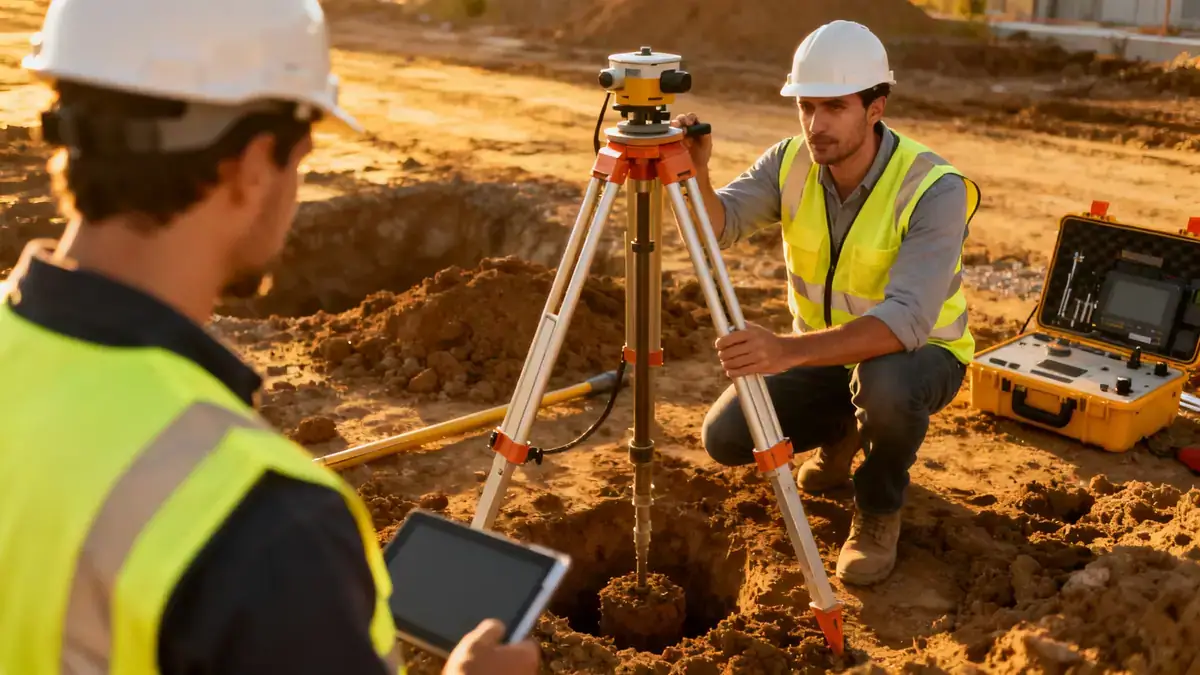
Our slope stability assessments follow a systematic approach aligned with Eurocode 7 and BS 5930. The process begins with a desk study and walkover survey to identify potential failure mechanisms. We then conduct subsurface investigations using rotary core drilling and trial pitting, with standard penetration tests (ASTM D1586) to derive shear strength parameters. Laboratory testing includes direct shear and triaxial compression on undisturbed samples. Limit equilibrium analyses (Bishop, Janbu, Morgenstern-Price) are performed using software such as SLOPE/W, with factors of safety computed for static and seismic conditions per ASCE 7. For complex sites, we incorporate finite element modelling to assess pore pressure effects. Our team has extensive experience with soil mechanics laboratory testing to refine input parameters.
Reference Technical Parameters
| Parameter | Reference Value |
|---|---|
| Factor of Safety (Static) | 1.3 – 1.5 (typical design) |
| Shear Strength (c') | 0 – 50 kPa (cohesive soils) |
| Friction Angle (φ') | 20° – 40° (granular soils) |
| Slope Angle | 15° – 45° (cut slopes) |
| Depth to Failure Surface | 2 – 15 m (typical) |
Local Considerations — United Kingdom
The UK's diverse geology—from the stiff clays of London and the Midlands to the glacial tills of northern England and the weak rock of Wales—requires region-specific approaches. In Aberdeen, weathered granite and steep topography necessitate deep drainage and rock bolting. In Ashford, the presence of soft alluvial soils along the River Stour demands careful groundwater control. Our firm adapts each analysis to local conditions, referencing historical landslide records and rainfall data. We maintain offices in key cities such as London, Manchester, and Edinburgh to ensure rapid response and local knowledge. For example, our work in Aberdeen has involved stabilisation of cut slopes for road widening projects.
Request a Quote
Our team reviews your project and issues an initial report at no cost.
Or write us directly at [email protected]
Applicable Standards
- Eurocode 7 (BS EN 1997-1:2004)
- BS 5930:2015 Code of practice for ground investigations
- Highways England CD 225 (Design for new pavement foundations)
- ASTM D1586 Standard Test Method for Standard Penetration Test
Frequently Asked Questions
What methods are used for slope stability analysis in the UK?
We primarily use limit equilibrium methods (Bishop, Janbu, Morgenstern-Price) and finite element analysis (e.g., PLAXIS). These are calibrated with site-specific soil parameters from laboratory testing and field investigations, following Eurocode 7.
What is the typical factor of safety required for UK slopes?
For permanent slopes, a factor of safety of 1.3 to 1.5 is common under static conditions. For temporary slopes or seismic loading, lower values may be accepted, but always in accordance with project-specific risk assessments and Eurocode 7.
How long does a slope stability investigation take?
A typical investigation including desk study, fieldwork, laboratory testing, and reporting takes 4 to 8 weeks. Complex sites with deep drilling or multiple failure surfaces may require longer, depending on access and weather.
How much does slope stability analysis cost in the United Kingdom?
Costs vary based on site complexity, depth of investigation, and number of boreholes. A typical investigation ranges from £5,000 to £20,000. For an accurate quote, please contact our team with project details.